What the Federal Office of Civil Protection Recommends
The Federal Office of Civil Protection and Disaster Assistance – or BBK for short – has been issuing recommendations for personal emergency preparedness since 2004. The core message is clear: every household in Germany should be able to provide for itself for at least ten days. If that's not possible all at once, even a three-day supply is a significant help.
Why ten days? Because, based on experience, in the event of a major incident – a multi-day power outage, a severe storm, a supply crisis – it can take that long for government assistance to arrive nationwide. During this time, you should be able to function independently of supermarkets, waterworks, and the power grid.
The following overview is based on the official BBK guide "Preparing for Crises and Disasters" and its accompanying checklist. We have organized it into understandable sections for you and provided specific quantities for one person for ten days.
1. Drinking Water – The Most Important Thing
A healthy person can survive several weeks without food. Without drinking water, only three days.
The BBK recommends 2 liters of drinking water per person per day. For one person for ten days, that's 20 liters – about ten standard 2-liter bottles from the supermarket. For a two-person household, the quantity doubles to 40 liters.
Additionally, you should have a means of water purification in your home in case tap water becomes undrinkable or the water supply completely fails. Water purification tablets and portable water filters, which filter out 99.99 percent of bacteria and protozoa, are suitable for this.
Our recommendation: A water filter like the Sawyer Mini has a capacity of 400,000 liters and weighs only 60 grams. Supplemented with Micropur Forte tablets, you are prepared even if clean tap water is no longer available.
→ View water filters & purification tablets at KRISENFEST
2. Food – Long-lasting, Compact, Edible Without Cooking
The BBK recommends around 2,200 kilocalories per person per day. For ten days, that's 22,000 kilocalories. It's crucial that the food has a long shelf life, doesn't require refrigeration, and ideally can be eaten without cooking – because if the power goes out, the stove won't work either.
Suitable foods according to the BBK checklist include canned whole-grain bread, rice, pasta, and potatoes (in shelf-stable form), canned vegetables, stews and ready meals, dried fruit and nuts, as well as compact emergency rations.
Emergency rations like NRG-5 are specially developed for crisis situations: one pack weighs 500 grams, provides 2,300 kilocalories, and has a shelf life of at least twenty years from the date of manufacture. The bars can be eaten dry, without water, without cooking, without preparation.
Also, don't forget the small things that make a big difference in a stressful situation: salt, sugar, coffee or tea, some chocolate. The BBK explicitly points out that personal preferences and dietary habits should be taken into account when compiling your supplies.
Our recommendation: With one NRG-5 carton (24 packs), you cover the food needs for one person for 24 days – or for two people for 10 days. Supplemented with canned bread, you'll have variety in your provisions.
→ View emergency food & long-term provisions at KRISENFEST
3. Light – When the Power Fails
No electricity means no light. The BBK checklist recommends several independent light sources. Flashlights or headlamps with spare batteries are the first choice because they work immediately and pose no fire hazard. Additionally, candles, tea lights, and matches or a lighter.
A rechargeable LED headlamp has the advantage of keeping both hands free – for cooking, packing, caring for children. Modern models last eight hours or more on a single charge.
Our recommendation: An LED headlamp with 1,000 lumens and USB-C charging belongs in every household. Compact, waterproof, ready for immediate use.
→ View LED headlamps & light sources at KRISENFEST
4. Communication – Receiving News Without the Internet
If electricity and internet fail, a battery- or crank-powered radio is the only way to receive official announcements and warnings. The BBK explicitly recommends having such a device in the household.
Modern crank radios combine several functions in one device: DAB+ and FM reception, LED flashlight, SOS signal light, small solar panel, and a built-in power bank that can charge a mobile phone in an emergency. Three energy sources – hand crank, solar, USB – make the device independent of batteries and power outlets.
Our recommendation: A crank radio with DAB+ and power bank function is one of the most important individual products for crisis preparedness. It costs under 50 euros and works without any external power source.
→ View crank radios & communication at KRISENFEST
5. Emergency Power – Operating Devices Without an Outlet
This point goes beyond the classic BBK checklist but is increasingly emphasized in the current version of the guide. In a world where we rely on mobile phones, medical devices, and refrigerators, an alternative power source can be crucial.
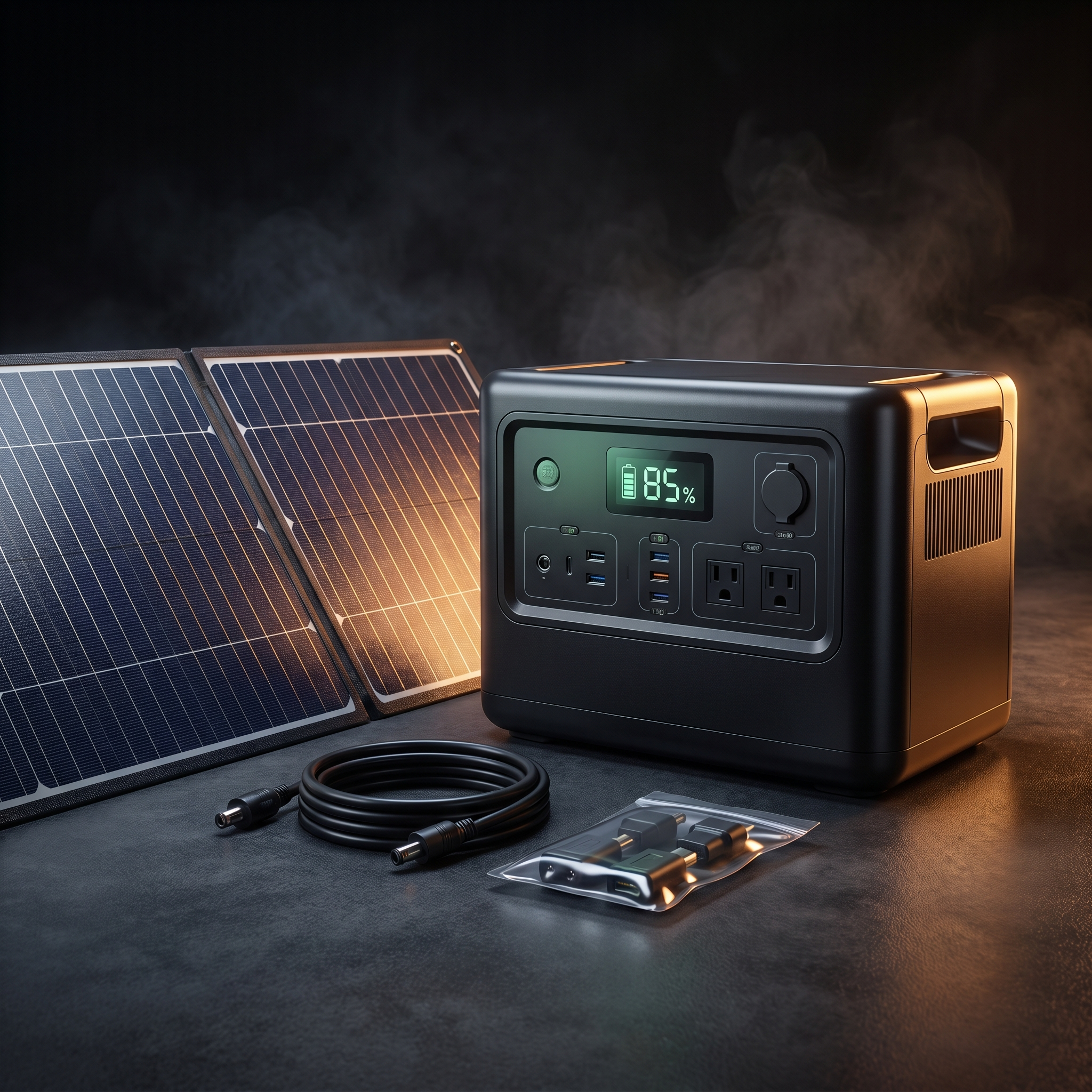
Portable power stations are large batteries with standard 230-volt outlets. You charge them at home, and in case of a power outage, you plug in your devices. No gasoline, no noise, no exhaust fumes. With a foldable solar panel, the power station can be recharged even without a power outlet.
Depending on the size, a power station can supply mobile phones and lamps for days (from 300 Wh), refrigerators and TVs for several hours (from 1,000 Wh), or the entire household including heating (from 2,000 Wh).
Our recommendation: A power station with a solar panel is the biggest single investment in your crisis preparedness – but also the most effective. From 349 Euros for an entry-level model to a complete household solution.
→ View power stations & solar panels at KRISENFEST
6. First Aid – Ensuring Basic Care
According to the BBK, a well-stocked first-aid kit belongs in every household. It should go beyond a car first-aid kit and contain at least the following: bandages and plasters in various sizes, scissors, tweezers, and disposable gloves, disinfectant and wound compresses, emergency blanket and triangular bandage, thermometer, and personal medications.
Particularly important: Anyone who takes medication regularly – blood pressure reducers, thyroid hormones, insulin, pain relievers – should always have at least a two-week supply at home. In an emergency, pharmacies rely on electricity and supply chains just as much as supermarkets.
Our recommendation: Our XL first-aid kit with 85 parts and a Molle pouch fits any backpack and fully covers the BBK recommendation.
→ View first-aid kits at KRISENFEST
7. Heat & Cooking – When the Heating Fails
The BBK checklist recommends warm sleeping bags or blankets in case the heating system stops working during a power outage. A well-insulated bivvy bag reflects 90 percent of body heat and weighs only 110 grams – a space-saving emergency solution.
Small camping stoves are suitable for cooking without electricity. An Esbit emergency stove weighs 85 grams, fits in any pocket, and can boil water within 12 minutes with one fuel tablet. Alternatively, gas stoves with cartridges also work.
Our recommendation: An emergency stove and a bivvy bag together cost under 30 euros and cover two critical areas that many people don't think about.
→ View stoves, bivvy bags & thermal protection at KRISENFEST
8. Documents & Cash
A point on the BBK checklist that most people forget: copies of the most important documents in a waterproof sleeve. The BBK specifically recommends copies of your ID card and passport, birth certificate and marriage certificate, insurance policies, vaccination certificate, land register excerpts and rental agreement, as well as bank details and emergency contacts.
Keep these both as paper copies and digitally on a USB stick. Both belong in a waterproof document bag that is easily accessible – ideally in an emergency backpack or by the front door.
And: keep cash ready. If ATMs don't work and card payments fail, cash is the only means of payment. The BBK recommends a small amount in various denominations.
9. Hygiene – Often Underestimated
When water supply is restricted, hygiene becomes a challenge. The BBK recommends a supply of soap and hand sanitizer, toothbrush and toothpaste, toilet paper, wet wipes as a substitute for showers, garbage bags in various sizes, household gloves, and hygiene articles for infants or persons in need of care if applicable.
10. Emergency Pack – If You Have to Leave Your Home
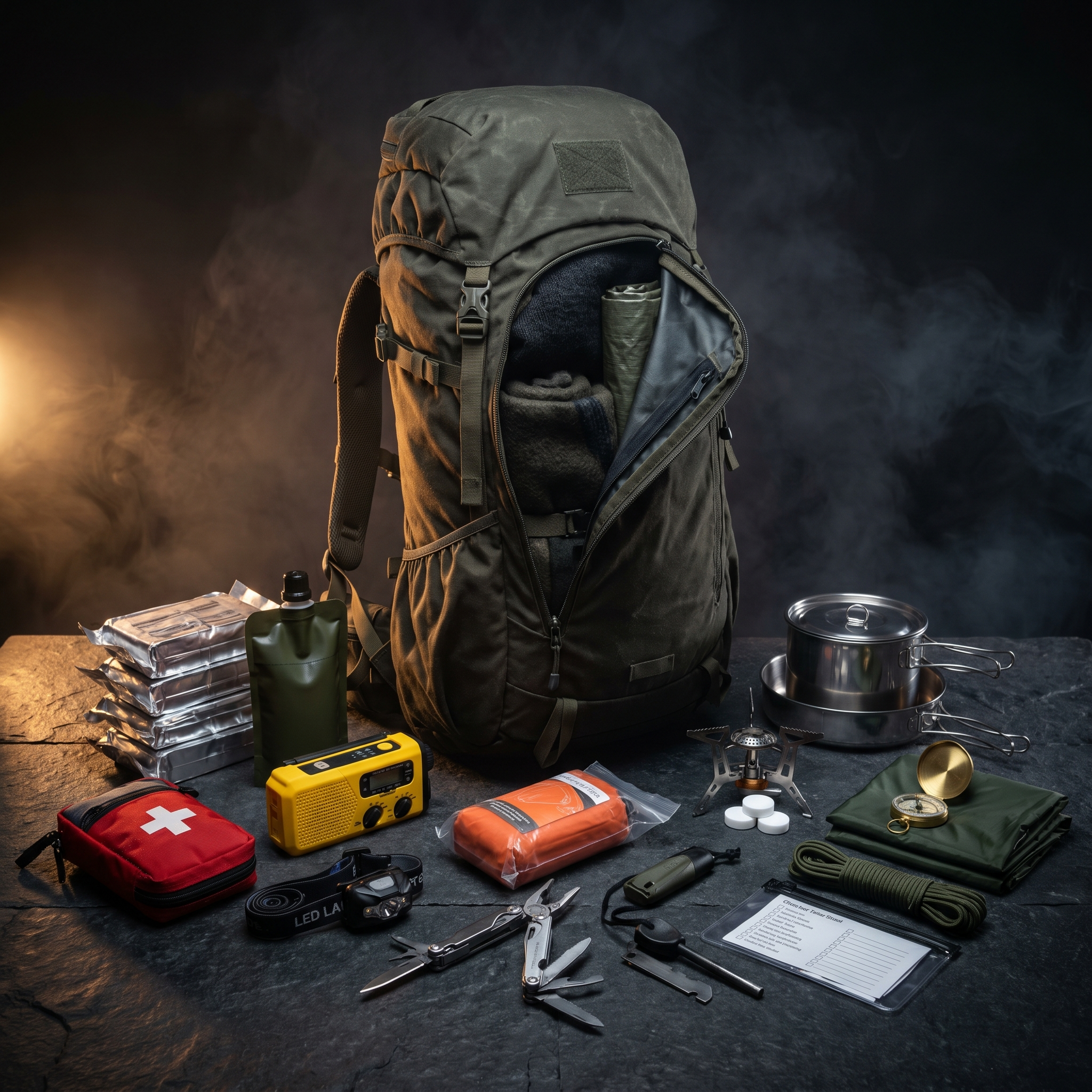
The BBK checklist distinguishes between household provisions and emergency packs. Household provisions remain at home and provide for you for days. The emergency pack is a packed backpack that you can quickly grab and take with you in case of evacuation.
The BBK recommends packing the backpack in advance and storing it within easy reach – in the hallway, next to the front door, or in the bedroom. It should contain food and water for at least 72 hours, plus first aid, communication (crank radio), light (headlamp), tools (multitool, fire starter), weather protection (poncho, bivvy bag), document copies, and some cash.
Our recommendation: Our emergency backpack sets contain all the components listed above as a complete self-packing kit. For 1 person, 2 persons, or the whole family – compiled according to the BBK checklist.
→ View emergency backpack sets at KRISENFEST
How to Start – Three Simple Steps
Crisis preparedness doesn't have to be perfect. The BBK explicitly emphasizes: even a three-day supply helps immensely. Start there and build up gradually.
Step one: Get water and food for three days. This can be done in an hour and costs under 40 Euros.
Step two: Ensure light and communication. A headlamp and a crank radio are sufficient as a basis.
Step three: Extend to ten days. Stock up on supplies, supplement the first-aid kit, pack an emergency backpack.
If you don't want to put together your own kit, we offer ready-made packages that cover the entire BBK checklist – from the starter package for 39.99 Euros to a complete family supply.
→ View all emergency packages at KRISENFEST
Download the Official BBK Guide
You can download the complete guide "Preparing for Crises and Disasters" as a free PDF from the Federal Office of Civil Protection:
→ Download BBK guide as PDF (bbk.bund.de)
→ Download BBK checklist for printing (bbk.bund.de)
Source: Federal Office of Civil Protection and Disaster Assistance (BBK), Guide "Preparing for Crises and Disasters", current version.